
A Legislative Update from Senator Keith Goehner
information released; photo above: Sen. Keith Goehner, R-Dryden, speaks with constituents before the 12th District Town Hall in Carnation.
Dear neighbors and friends,
In mid-October, the 12th District team Rep. Mike Steele, Rep. Brian Burnett, and I, convened before a full house at Miller’s in Carnation for a town hall focused on the issues affecting west side communities each day.
The City of Carnation helped make it possible, and I’m grateful to Mayor Jim Ribail for his warm welcome and to City Manager Rhonda Ender for the behind-the-scenes coordination that kept everything running smoothly. Our sincere thanks as well to Miller’s Event Venue for the beautiful, accommodating space.
Over the hour, we discussed highlights from the 2025 session, previewed priorities for 2026, and addressed questions on housing affordability, transportation, tax policy, education, and more. The common theme was clear: you want practical solutions, transparency, and steady collaboration among local and state partners.
The questions and feedback help us bring the 12th District’s voice to Olympia and keep our work rooted in what’s really happening in Carnation, the Snoqualmie Valley, and across North Central Washington.
Town halls like this are about listening first. If you could not attend or thought of something after you left, please reach out by contacting my office at keith.goehner@leg.wa.gov or by phone to 360-786-7954.
Sincerely
 |
Keith Goehner, R-Dryden
Washington State Senate
Farmers don’t need more government programs; they need fewer barriers
Last month, I participated in a roundtable discussion in Wenatchee with Gov. Bob Ferguson and local farmers and tree fruit growers. While I appreciate the governor taking the time to meet with our agricultural community, the conversation reinforced something I’ve seen throughout my career: the future of Washington agriculture depends far more on removing barriers than on creating new government programs.
The harsh truth is that many challenges facing our farmers today come straight from Olympia — taxes, regulations, and mandates that increase costs and reduce flexibility. If state leaders truly want agriculture to succeed, we must cut unnecessary programs and remove the barriers that are keeping our farms and orchards from being profitable.
The governor cited the Climate Commitment Act (CCA) as a success for both the environment and the economy. I completely disagree. The CCA’s carbon-pricing scheme has hurt farmers and orchardists by raising fuel and transportation costs and squeezing their already thin margins. No one cares more about the environment than farmers. Every day, we work to improve soil health, conserve water, and naturally capture carbon through our crops. Policies that penalize these efforts do not promote sustainability — they undermine it.
 |
Washington Wildfires: Urgency, strategy, and action
Over the past few months, Washington has once again battled wildfires impacting communities across the state. Although cooler, wetter weather has finally eased some of the pressure, this year’s fire season serves as a reminder that wildfire risk remains constant, especially in rural and forested areas of our district.
There are currently two large wildfires still burning in Washington State. The Bear Gulch Fire on the Olympic Peninsula has burned over 20,000 acres and is only 50% contained. In Central Washington, the Labor Mountain Fire is still active near Cle Elum, and the Lower Sugarloaf Fire is now 99% contained.
Smoke from these fires continues to affect air quality across valleys and nearby communities. According to state data, Washington recorded 1,851 fire ignitions and more than 250,000 acres burned during this season—more individual fires than last year, even though the total acreage is slightly lower.
|
Rural infrastructure cannot wait
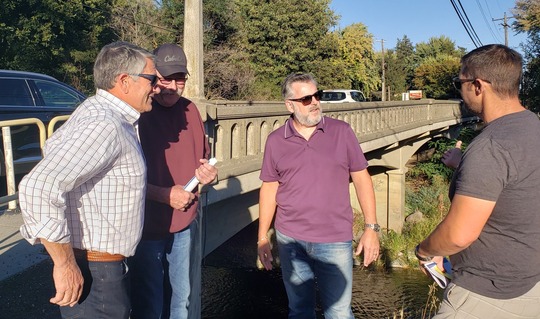 |
During a Joint Transportation Committee tour in early October, Sen. Goehner and committee members made a stop at the Waitsburg bridge on US 12 to view some of the needed repairs.
As a long-time supporter of safe and reliable transportation across our state, I recently participated in the Joint Transportation Committee tour to SE WA and witness first hand the urgent need to replace the US-12 bridge in Waitsburg.
Built in 1931, this narrow bridge was designed for Model T cars, not the heavy semi-trucks that now cross it daily. While the bridge has served the community well for nearly a century, it is clear that it no longer meets the demands of modern transportation or the safety needs of local residents. Although this bridge is critical it is only one of many we should highlight all district bridges.
The community first recognized the need for replacement in 2007–2008, when the project’s estimated cost was $3.6 million. Today, the price has soared to at least $10 million — a clear reminder of how delays and stricter regulations have driven up the costs of even essential infrastructure.
|
Protecting civility and the people’s voice
Across Washington, we have encountered troubling reports of harassment and intimidation toward citizens collecting signatures for statewide initiatives. These are not isolated incidents — they reflect a growing disregard for respectful dialogue and civic participation that are meant to define our state’s democratic process.
My colleague Sen. Jeff Wilson, R–Longview, is working on legislation to strengthen protections for signature gatherers and give law enforcement clear authority to respond to harassment. His proposal would impose stricter penalties for anyone who interferes with signature collection, including:
- Establishing a gross misdemeanor for protesting within 25 feet of a signature gatherer.
- Making it a gross misdemeanor to deface or destroy petitions.
- Elevating repeat offenses or theft of petitions to Class C felonies.
To email my office, please email keith.goehner@leg.wa.gov